Chasing Light and Magic: How Avignon Turns Every Moment Into a Photo Story
Have you ever walked through a city that feels like a living film set? Avignon isn’t just stone walls and history—it’s golden sunsets on ancient bridges, vibrant street performances, and markets bursting with color. I was there last summer, camera in hand, and every turn offered a shot worth remembering. This is where experience meets imagery, and every moment begs to be captured. More than a destination, Avignon is a canvas painted with light, culture, and centuries of stories waiting to be seen through the lens. For travelers who cherish both beauty and authenticity, this Provençal gem offers not just sights, but moments that linger in memory—and in photographs.
The Stage Is Set: Avignon’s Visual Soul
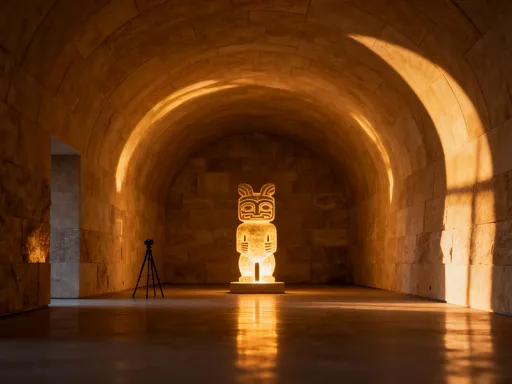
Avignon’s visual power begins with its grandeur and intimacy in equal measure. At its heart stands the Palais des Papes, a fortress-like papal palace rising from the banks of the Rhône River. Its imposing limestone walls glow in the afternoon sun, casting long shadows across cobbled courtyards. This UNESCO World Heritage Site is not only one of Europe’s largest and most important medieval Gothic buildings but also a masterclass in architectural drama. Photographers find endless compositions here—symmetrical archways, weathered stone textures, and vaulted halls that echo with history. The way light filters through narrow stained-glass windows creates natural spotlights, turning even still interiors into cinematic scenes.
But Avignon’s magic isn’t confined to grand monuments. The city’s medieval street grid, largely unchanged for centuries, offers a rhythm of discovery. Narrow lanes twist and open into sunlit plazas, each with its own character. Rue de la République, lined with boutiques and cafés, becomes a stage for everyday life—children chasing pigeons, elders reading newspapers under plane trees, artists sketching on benches. These spontaneous moments are the soul of visual storytelling. The city’s palette—ochre walls, terracotta roofs, iron-latticed balconies—creates a warm, earthy tone that harmonizes beautifully in photographs.
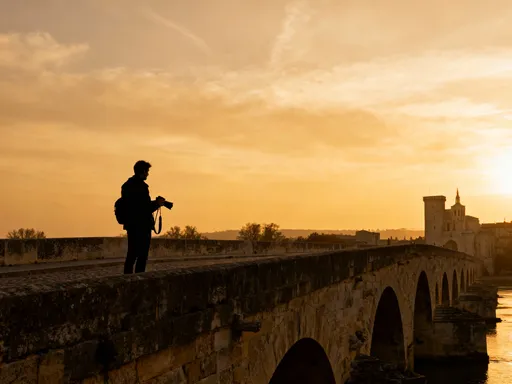
Timing elevates these scenes from good to unforgettable. The golden hour, just after sunrise and before sunset, bathes Avignon in soft, diffused light. During this time, the Pont Saint-Bénézet—famously known as the Pont d’Avignon—transforms. Though only a fragment of the original bridge remains, stretching partway into the Rhône, it becomes a powerful silhouette against the glowing sky. Positioning a lone figure walking across its arches adds scale and emotion. Similarly, the shoulder seasons of spring and autumn offer ideal conditions: fewer crowds, mild temperatures, and light that enhances depth and texture without harsh contrasts. Early mornings in May or late afternoons in September yield images that feel both vivid and serene.
To make the most of iconic views, consider composition techniques that add dynamism. Use leading lines—such as the curve of the river or the arc of the bridge—to draw the eye into the frame. Include natural elements like swaying reeds or rippling water to introduce movement. A polarizing filter can deepen blue skies and reduce glare on water surfaces, enhancing clarity. Most importantly, allow time to observe. Wait for the right moment—a cyclist pausing mid-span, a bird taking flight—before pressing the shutter. In Avignon, patience is rewarded with images that feel alive.
Morning Light & Local Life: Starting Your Day Behind the Lens
There is a quiet magic in Avignon before the city fully wakes. Around 6:30 a.m., when the streets are still damp from overnight mist and the first sunlight spills over rooftops, the city reveals its most intimate side. This is the perfect time to capture local life in its most authentic form. The Les Halles market, located just inside the city walls, begins to stir. Vendors unpack crates of cherries, apricots, and figs, their colors almost too vibrant to believe. Stalls overflow with wheels of goat cheese, jars of honey, and bouquets of wild herbs. A photographer here doesn’t need dramatic angles—sometimes the simplest close-up of a hand arranging strawberries tells the fullest story.
Adjacent to the market, boulangeries open their doors, releasing waves of warm, yeasty air. The sight of golden baguettes stacked in wooden racks or croissants glistening with sugar is more than appetizing—it’s visually rich. Early morning light slants through shop windows, illuminating flour-dusted countertops and the focused expressions of bakers at work. These scenes offer texture, warmth, and human connection, all essential ingredients for compelling travel photography. A wide-aperture lens, such as a 50mm f/1.8, allows for soft background blur while keeping key details sharp, creating a sense of presence and intimacy.
Respectful street photography is crucial when capturing people in their daily routines. Avoid intrusive behavior—never use a telephoto lens to zoom in on private moments. Instead, engage with a smile, nod, or simple “Bonjour.” Many locals appreciate genuine interest and may even invite you to photograph their stall or share a story. This builds trust and results in more natural, expressive images. When photographing children, always seek permission from parents. The goal is not to take pictures of people, but to include them as part of the city’s living fabric.
Equipment choices matter when moving through narrow streets and bustling markets. A lightweight mirrorless camera or advanced compact is ideal—easy to carry and discreet. Pair it with a versatile zoom lens (24-70mm) for flexibility, and a prime lens for low-light situations. Keep your bag small and secure. Most importantly, move slowly. Don’t rush from scene to scene. Sit at a café for 20 minutes and watch the rhythm of the street. You’ll notice patterns—a delivery scooter arriving at the same time each day, an old man feeding pigeons at the fountain—that become the heart of a visual narrative. In these quiet hours, Avignon doesn’t perform for the camera; it simply lives, and that’s what makes the images endure.
Festival in Focus: Capturing the Avignon Festival’s Energy
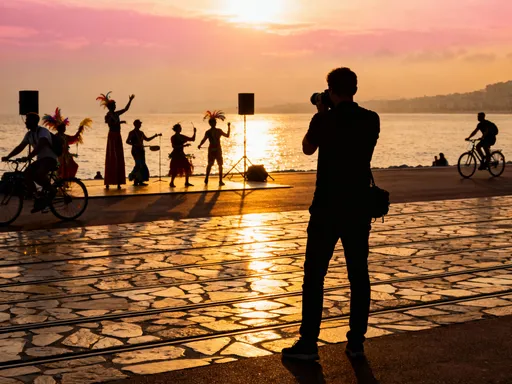
Every July, Avignon undergoes a transformation. The Avignon Festival—officially known as the Festival d’Avignon—turns the entire city into an open-air theater. Founded in 1947, it is one of the most prestigious performing arts events in Europe, attracting thousands of artists, performers, and audiences from around the world. For photographers, this is a period of unmatched visual energy. The city pulses with color, sound, and motion. Courtyards become impromptu stages, alleyways echo with music, and actors in elaborate costumes parade through the streets. This is not a festival confined to theaters—it spills into the public realm, offering endless opportunities for dynamic, expressive photography.
One of the most striking aspects of the festival is its diversity. Performances range from classical theater to experimental dance, from puppet shows to spoken word. Many are free and take place in historic spaces—the courtyard of the Palais des Papes, the Cloître des Carmes, or the Jardin des Doms. These settings add layers of texture and contrast: ancient stone backdrops against modern costumes, solemn architecture juxtaposed with joyful chaos. Photographers can capture the anticipation before a show—actors applying makeup in dimly lit corners, audience members finding their seats on wooden benches—or the intensity of performance itself, where emotion is writ large on the face and body.
To photograph motion effectively, use shutter speed creatively. A faster shutter (1/500 sec or higher) freezes action, perfect for capturing a dancer mid-leap or a musician striking a chord. A slower shutter (1/30 sec or slower), combined with panning, can convey movement—blurred limbs, flowing fabric, the swirl of a crowd. Experiment with angles: shoot from ground level to emphasize scale, or from above using a balcony or staircase for a wider view. The key is to stay mobile and responsive. The festival’s energy is unpredictable, and the best moments often happen spontaneously—a clown suddenly juggling for children, a street musician joined by a passing violinist.
Color plays a central role in festival photography. Costumes are often bold and theatrical—crimson capes, gold masks, patchwork outfits—that stand out vividly against Avignon’s muted stone. Use this contrast to your advantage. Position subjects against neutral walls to make hues pop. Pay attention to lighting—many performances happen in natural light, so overcast days can actually be beneficial, providing even illumination without harsh shadows. If shooting indoors or at night, increase ISO carefully to maintain image quality, and consider using available light rather than flash, which can disrupt the atmosphere and distract performers.
Respect remains essential. Always check if photography is permitted during a performance—some artists and venues have restrictions. When in doubt, ask quietly or observe what others are doing. Never block sightlines or interfere with the show. The goal is to document, not disrupt. By blending in and staying alert, photographers can capture not just images, but the spirit of the festival—its creativity, its joy, its sense of collective celebration. These are the moments that, when viewed later, transport you back to the heartbeat of Avignon in summer.
Hidden Corners: Offbeat Spots That Photograph Like Dreams
Beyond the main squares and tourist trails, Avignon holds quieter, more intimate spaces—places where time seems to slow and beauty reveals itself in subtle ways. These hidden corners are not marked on most maps, but they often yield the most memorable photographs. The Courtyard of the Hôtel de Villeneuve-Martignan, now home to the Calvet Museum, is one such place. Surrounded by Renaissance arches and shaded by plane trees, it offers a sense of calm. Morning light filters through the leaves, casting dappled patterns on the stone floor. A single bench, a potted olive tree, a cat stretching in the sun—these small details create compositions that feel poetic rather than staged.
Another gem is the Jardins du Rocher des Doms, perched on a limestone outcrop overlooking the Rhône. While the garden itself is well-known, few visitors explore its eastern edge, where a narrow path winds beneath ivy-covered walls. Here, the city feels distant, and the view opens toward distant hills and vineyards. A telephoto lens can compress the scene, bringing the distant Mont Ventoux into frame alongside the river’s curve. Return at different times—early morning fog, midday clarity, twilight glow—and each visit yields a new image. The garden’s rose beds, especially in June, add splashes of pink and crimson, perfect for close-ups or reflective shots in puddles after rain.
Discovering these spots requires curiosity and a willingness to wander without a fixed plan. Put the GPS away and let intuition guide you. Turn down alleys that catch your eye—the ones draped with climbing roses, lined with artisan workshops, or echoing with the sound of a fountain. Talk to local shop owners. A bookseller, a potter, or a florist might mention a quiet cloister nearby or a family-run vineyard just outside the walls. These personal recommendations often lead to the most authentic experiences. Return to favorite places at different times of day. A sunlit courtyard in the afternoon may become a pool of shadows and mystery at dusk, with only a single lamp glowing in a window.
One overlooked location is the small square near Rue du Chapelet, where a 14th-century fountain still flows. Surrounded by pastel-colored houses with flower boxes, it feels untouched by time. Early on a weekday, you might have the entire space to yourself. The sound of water, the texture of weathered stone, the way light hits the moss—these sensory details translate powerfully into images. Use a macro lens to capture the veins of a leaf floating in the basin, or a wide-angle to include the surrounding architecture. The key is to slow down, observe, and let the place speak through your lens. In these quiet moments, photography becomes not just an act of seeing, but of listening.
Colors of the South: How Provençal Culture Feeds the Frame
Provence is a region defined by color, and Avignon, as one of its cultural centers, wears this identity proudly. The palette is unmistakable: sun-bleached terracotta, sky-blue shutters, lavender-gray stone, and the vibrant reds and yellows of market produce. These hues are not accidental—they reflect the land, the light, and a way of life rooted in simplicity and beauty. For photographers, they offer a ready-made composition, a harmony that requires little adjustment to feel balanced and evocative.
One of the most iconic Provençal elements is the striped textile—often seen in café awnings, tablecloths, or sailor shirts. These bold red-and-white or blue-and-white patterns add rhythm and energy to a frame. Position them as background elements behind a still life—a coffee cup, a newspaper, a pair of sunglasses—and they immediately evoke the South of France. Similarly, terracotta roof tiles, arranged in gentle waves across the cityscape, create texture and movement in wide-angle shots. When sunlight hits them at an angle, the warm tones deepen, adding richness to the image.
Markets remain the most colorful stage. Stalls overflow with tomatoes in every shade—crimson, orange, deep purple—stacked like jewels. Bunches of thyme and rosemary release their scent with every breeze. Piles of olives, glossy and dark, sit beside wheels of pale cheese. These scenes invite close-up photography. Use a shallow depth of field to isolate a single fig on a wooden board, its skin split open to reveal pink flesh. Or capture the hand of a vendor placing a sprig of lavender into a customer’s basket—movement, texture, and tradition in one frame.
Color also tells cultural stories. The blue of a painted door may reflect Mediterranean influence; the red of a geranium in a pot speaks to the region’s love of gardening. Even the food carries meaning: a dish of ratatouille, with its layers of eggplant, zucchini, and bell peppers, is a edible rainbow. Photographing these elements isn’t just about aesthetics—it’s about documenting a way of life that values seasonality, craftsmanship, and the beauty of the everyday. Combine close-ups with wider scenes to create a narrative. Start with a wide shot of the market, then a medium shot of a vendor, then a close-up of hands exchanging coins and produce. Together, they form a visual story that goes beyond the surface.
Beyond the Snapshot: Turning Moments into Meaningful Stories
A photograph can capture a face, a place, or a moment—but a photo story captures meaning. In Avignon, where every corner seems designed for the lens, the challenge isn’t finding things to shoot, but choosing what to say with your images. Moving beyond the snapshot means thinking like a storyteller. It means considering sequence, emotion, and context. It means asking not just “What do I see?” but “What do I feel?” and “What do I want to share?”
Composition is the first tool in this process. Leading lines—such as the curve of a cobblestone street or the edge of a shadow—can guide the viewer’s eye through the frame. The rule of thirds helps balance elements, placing a lone figure in one corner while leaving space for the sky or architecture. Including human elements, even small ones—a child’s hand holding a balloon, an elderly couple sharing a bench—adds emotional weight. Contrast, too, is powerful: the softness of a flower against rough stone, the brightness of a market stall against a shadowed alley.
Consider curating photo sequences. Follow a single thread through the day. Begin with early light on an empty street, then move to the market awakening, then a vendor arranging fruit, then a customer selecting produce, then a family sharing a meal in a sunlit square. These images, viewed together, tell a richer story than any single shot. They show time, change, and connection. Editing should support this narrative. Avoid over-processing—excessive filters or saturation can distort reality. Instead, enhance clarity, adjust contrast subtly, and preserve natural tones. The goal is not to alter the moment, but to honor it.
Finally, reflect on intention. Why take these photos? Is it to remember? To share? To understand a place more deeply? In Avignon, where history and daily life intertwine, photography becomes a form of engagement. It invites you to look closely, to pause, to appreciate. The most powerful images are not always the most dramatic—they are the ones that feel true. A wrinkled hand placing a coin in a beggar’s cup. A laugh caught mid-air. A shadow stretching across an ancient wall. These are the moments that stay with you, not because they are perfect, but because they are real.
Why Avignon Stays With You—And Your Camera Roll
Avignon does not let go easily. Long after the suitcase is unpacked and the photos are sorted, something lingers—the warmth of the light, the rhythm of the streets, the sense of walking through layers of time. It is a city that engages all the senses, but especially the eye. Its beauty is not staged for tourists; it is lived, worn, and deeply rooted in place. This authenticity is what makes its images endure. They are not just souvenirs, but records of experience—of a morning coffee sipped under a plane tree, of laughter shared at a street performance, of silence in a sunlit courtyard.
The emotional resonance of Avignon comes from its balance—between history and modernity, grandeur and intimacy, stillness and celebration. It is a city that allows you to be both observer and participant. You can stand in awe of the Palais des Papes, then minutes later be handed a sample of honey at a market stall with a smile. This duality enriches visual storytelling. Your photos capture not just what the city looks like, but what it feels like to be in it.
For the thoughtful traveler, Avignon offers a lesson in intentionality. It reminds us to travel with open eyes, but also with an open heart. To seek not just the perfect shot, but the true moment. To move slowly, listen closely, and let the place reveal itself in its own time. When you do, the camera becomes more than a tool—it becomes a companion in discovery.
So return to Avignon with your lens charged and your spirit ready. Let the light guide you. Let the colors speak. Let the quiet corners surprise you. And when you look back at your photos, may you not only see a beautiful city, but remember how it made you feel—alive, present, and deeply connected to the world. That is the real magic of Avignon. That is why it stays with you, long after you’ve left.