You Won’t Believe These Alien-Like Structures in the Atacama Desert
Nestled high in northern Chile, the Atacama Desert isn’t just the driest place on Earth—it’s a living canvas of architectural wonders shaped by ancient traditions and extreme conditions. From centuries-old adobe villages to modern observatories blending into the desert, every structure tells a story. This is a land where rainfall is measured in decades, where the sun blazes relentlessly by day and temperatures plummet at night. Yet, amid this starkness, human ingenuity has flourished. Architecture here does not merely respond to the environment—it evolves with it. In this high-altitude wilderness, buildings are not just shelters but statements of resilience, culture, and harmony with nature. The Atacama reveals how design can thrive even in the harshest environments, offering lessons for sustainable living far beyond its borders.
Introduction: The Atacama’s Unexpected Architectural Allure
The Atacama Desert stretches across northern Chile, bordered by the Andes to the east and the Pacific Ocean to the west, creating a rain shadow so complete that some weather stations have never recorded rainfall. With elevations ranging from sea level to over 4,000 meters, the region features salt flats, geysers, volcanic peaks, and vast arid plains. Despite its otherworldly appearance, the desert has supported human life for thousands of years. Its extreme climate—characterized by intense solar radiation, minimal humidity, and dramatic temperature swings—has shaped a unique architectural identity. What makes Atacama’s built environment remarkable is not grandeur or ornamentation, but its profound responsiveness to nature.
Architecture in the Atacama is defined by necessity. Without abundant timber or water, builders have long relied on earth, stone, and local knowledge. The resulting structures appear simple but are deeply sophisticated in their adaptation. Thick walls, compact layouts, and strategic orientation are not stylistic choices—they are survival strategies. This architectural humility creates a powerful aesthetic, one that merges seamlessly with the surrounding landscape. Visitors often describe the experience as walking through a dreamscape, where buildings seem to grow organically from the ground. The desert’s alien-like terrain is matched by structures that feel equally out of this world, yet are firmly rooted in practical wisdom.
What emerges is a rare fusion of function and beauty. The Atacama challenges the assumption that great architecture requires wealth or advanced technology. Instead, it demonstrates how constraint can inspire innovation. Whether ancient or modern, religious or scientific, the buildings of this region reflect a deep understanding of place. They are not imposed upon the environment but emerge from it. This harmony between human creation and natural forces gives the Atacama its architectural allure—a quiet brilliance that speaks to sustainability, cultural continuity, and the enduring power of design.
Ancient Foundations: Pre-Columbian Settlements and Adobe Wisdom
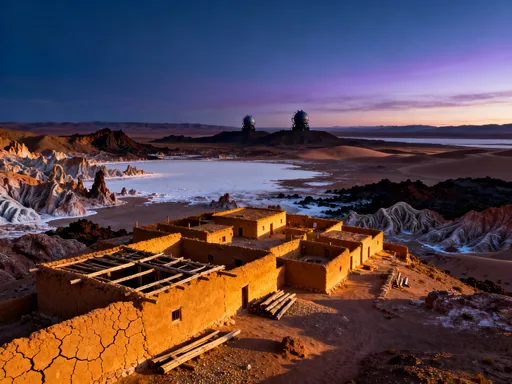
Long before European contact, indigenous communities such as the Atacameño people developed sophisticated ways of living in balance with the desert. Their settlements, particularly around present-day San Pedro de Atacama, showcase an architectural legacy built on observation, adaptation, and respect for materials. Central to this tradition is the use of adobe—sun-dried bricks made from clay, sand, water, and sometimes straw. These bricks have been used for centuries due to their abundance and effectiveness in regulating indoor temperatures. During the day, adobe walls absorb heat, preventing interiors from becoming unbearable; at night, they slowly release stored warmth, countering the desert’s rapid cooling.
The design of pre-Columbian homes was both practical and communal. Houses were typically low to the ground, with flat roofs supported by wooden beams, often sourced from algarrobo or chañar trees. Rooms were small and interconnected, minimizing surface area exposed to the elements. Courtyards served as shared spaces for cooking, socializing, and protection from wind. Doorways were intentionally narrow to reduce heat exchange and dust infiltration. These features, developed over generations, reflect a deep understanding of environmental dynamics. There was no trial and error—only accumulated knowledge passed down through oral tradition and lived experience.
Today, many of these ancestral techniques continue to influence local construction. In rural areas, families still build homes using adobe, preserving methods that require minimal machinery and external resources. Architects and sustainability experts study these practices for insights into passive climate control and low-impact building. The durability of well-maintained adobe structures—some over 500 years old—demonstrates their resilience. Moreover, the material’s natural composition allows for easy recycling; when a building reaches the end of its life, its walls can be returned to the earth without pollution. In an era focused on reducing carbon footprints, the ancient wisdom of Atacama’s builders offers a compelling model for eco-conscious design.
Sacred Spaces: The Spiritual Architecture of Desert Churches and Shrines
Among the most striking architectural remnants in the Atacama are its historic churches, many dating back to the 16th and 17th centuries. Built during the Spanish colonial period, these sacred spaces represent a fusion of European religious intent and indigenous craftsmanship. Unlike the ornate cathedrals of Europe, Atacama’s churches are modest in scale but profound in presence. Constructed primarily from adobe, they feature thick walls, small windows, and sturdy wooden beams. These design choices were not only functional but symbolic—creating interiors that remain cool during the day and warm at night, offering refuge both physically and spiritually.
One of the most renowned examples is the Church of San Pedro de Atacama, originally built in the 17th century and reconstructed after multiple earthquakes. Its bell tower stands slightly apart from the main structure—a deliberate safety measure to protect the congregation if the tower collapses. The church’s exterior is painted in warm ochres and browns, blending with the desert hues. Inside, the altar is adorned with religious paintings and carvings that reflect a blend of Catholic iconography and local artistic expression. This synthesis of cultures is evident in the details: saints depicted with indigenous facial features, textiles woven in traditional patterns, and altars made from native wood.
Preservation efforts have been ongoing, led by local communities and supported by national heritage organizations. Because adobe is vulnerable to erosion from wind and rare rainfall, maintenance is essential. Residents regularly reapply protective mud coatings, a practice known as "enfoscado," which helps seal the walls against moisture. These collective efforts underscore the cultural value placed on these buildings—not just as places of worship, but as anchors of identity and continuity. For many families, generations have been baptized, married, and celebrated within these walls. The endurance of these churches speaks to a deeper truth: architecture can embody memory, faith, and belonging, even in the most remote corners of the world.
Living in Extremes: How Modern Communities Adapt Their Homes
Contemporary life in the Atacama continues to demand architectural innovation. While modern materials and technologies are available, many residents choose to maintain traditional forms, adapting them to current needs. Homes in villages like San Pedro, Peine, and Socaire are designed with climate responsiveness at their core. Walls remain thick, often exceeding 50 centimeters, to provide thermal mass. Roofs are flat, allowing for outdoor use during cooler evenings, and are sometimes reinforced with modern waterproof membranes to protect against occasional storms.
Ventilation is carefully managed. High windows or clerestories allow hot air to escape while drawing in cooler air from below. Some homes incorporate shaded patios or covered walkways—known locally as "corredores"—that create microclimates for comfortable outdoor living. Orientation plays a crucial role; buildings are positioned to maximize southern exposure in the Southern Hemisphere, capturing sunlight during winter months while minimizing direct exposure during the intense summer heat. These passive strategies reduce reliance on mechanical heating or cooling, lowering energy consumption and costs.
Community planning also reflects adaptation to isolation and environmental conditions. Houses are often clustered together, sharing walls to conserve heat and create sheltered communal spaces. Narrow streets provide shade and reduce wind exposure. Water conservation is integrated into design, with systems for collecting and storing rainwater during the rare precipitation events. Solar panels are increasingly common, providing reliable electricity in areas far from the national grid. These adaptations demonstrate how modern life can coexist with tradition, creating homes that are both functional and culturally meaningful. The architecture of everyday life in the Atacama is not about spectacle—it is about sustainability, resilience, and community.
Science Meets Design: The Rise of Astronomical Observatories
The Atacama Desert is home to some of the most advanced scientific facilities on the planet, particularly in the field of astronomy. Its high altitude, clear skies, and minimal light pollution make it an ideal location for observing the universe. Facilities such as the Atacama Large Millimeter/submillimeter Array (ALMA) and the Paranal Observatory, operated by the European Southern Observatory (ESO), stand as testaments to human curiosity and engineering excellence. Yet, these cutting-edge installations are not just feats of science—they are also achievements in architectural integration.
ALMA, located on the Chajnantor Plateau at over 5,000 meters above sea level, consists of 66 high-precision antennas spread across a vast plain. The site includes a technical building, control rooms, and support infrastructure, all designed to function in extreme conditions. Architecture here prioritizes functionality and durability. Buildings are low-profile to resist strong winds, constructed with insulated panels to maintain stable internal temperatures, and painted in neutral tones to minimize visual impact. Even the access roads are carefully planned to avoid disturbing the fragile desert ecosystem.
At Paranal, home to the Very Large Telescope (VLT), the main observatory buildings are embedded into the top of Cerro Paranal, reducing their silhouette against the sky. The residence for staff and visiting scientists, known as the Residencia, is partially buried into the mountain, providing natural insulation and stunning views of the surrounding desert. Designed by German architect Auer + Weber, the Residencia features a futuristic interior with curved walls, a large indoor pool, and abundant natural light—creating a comfortable sanctuary in an otherwise inhospitable environment. Its construction was a delicate balance between human comfort and environmental sensitivity, using materials transported from distant locations to avoid disturbing local resources.
What sets these observatories apart is their commitment to coexistence with the landscape. Unlike urban research centers, they do not dominate their surroundings. Instead, they recede into the terrain, respecting the silence and stillness of the desert. This architectural humility enhances their scientific purpose: to observe the cosmos without interference. At the same time, they serve as symbols of international collaboration and the pursuit of knowledge. In a place where ancient peoples once mapped the stars with the naked eye, modern astronomers now explore distant galaxies—connected across time by the same clear night sky.
Eco-Lodges and Sustainable Tourism Architecture
As tourism grows in the Atacama, so does the demand for accommodations that respect the environment. Eco-lodges have emerged as a model for responsible hospitality, combining guest comfort with ecological stewardship. These properties are designed to leave minimal footprints while offering immersive experiences of the desert landscape. One notable example is the design philosophy seen in lodges such as Alto Atacama Desert Lodge & Spa and Tierra Atacama Hotel & Spa, which prioritize passive solar heating, water recycling, and the use of local, renewable materials.
Architectural features are tailored to the climate. Large south-facing windows capture sunlight during winter, while overhangs and shaded terraces prevent overheating in summer. Walls are constructed with double layers—often adobe or stone on the exterior and insulating materials within—to maintain stable indoor temperatures. Roofs are designed to collect rainwater, which is filtered and reused for irrigation and non-potable purposes. Solar energy powers lighting, heating, and water systems, reducing dependence on fossil fuels. Some lodges even incorporate composting toilets and organic waste management to close the sustainability loop.
Interior spaces are designed to connect guests with nature. Open floor plans, natural textures, and earth-toned palettes create a sense of calm and continuity with the outside world. Courtyards and outdoor lounges invite relaxation under star-filled skies. The spatial layout encourages mindfulness, slowing down the pace of life in contrast to fast-moving urban routines. Staff often include local community members, supporting regional employment and cultural exchange. Educational programs about desert ecology, astronomy, and traditional craftsmanship further deepen the guest experience.
These eco-lodges demonstrate that luxury and sustainability are not mutually exclusive. Comfort is achieved not through excess, but through thoughtful design. Guests enjoy warm rooms, hot showers, and gourmet meals—all while knowing their stay contributes to conservation rather than degradation. By aligning architecture with environmental ethics, these lodges set a standard for responsible tourism in fragile ecosystems. They prove that travel can be transformative not only for visitors but for the places they visit.
Contrasts and Continuities: Bridging Past and Future Through Design
At first glance, the adobe homes of ancient Atacameño villages and the high-tech observatories of today seem worlds apart. One relies on hand-molded earth, the other on satellite-linked instruments. Yet, when examined closely, they share fundamental principles. Both are born of necessity, shaped by the same unforgiving environment. Both prioritize efficiency, resilience, and harmony with the landscape. The continuity between past and present reveals a timeless truth: great architecture responds to context, not trends.
Traditional and modern builders alike understand the importance of thermal regulation. While pre-Columbian architects used adobe’s natural properties, contemporary designers employ advanced insulation and passive solar techniques—but the goal remains the same: to create stable, comfortable interiors without excessive energy use. Similarly, both approaches favor local materials to reduce transportation costs and environmental impact. Even the observatories, despite their global funding and technology, are built with sensitivity to the land, avoiding large-scale excavation or visual intrusion.
Another shared value is community. Ancient settlements were organized around collective well-being, with shared courtyards and defensive layouts. Today’s eco-lodges and research stations also emphasize communal spaces—dining areas, observation decks, and gathering halls—that foster connection among residents and visitors. In a region defined by isolation, architecture becomes a tool for bringing people together. Whether for worship, science, or hospitality, the built environment supports social cohesion.
Looking ahead, the Atacama offers lessons for desert architecture worldwide. As climate change increases aridity in many regions, the strategies perfected here—passive cooling, water conservation, renewable energy integration—become increasingly relevant. Urban planners and architects are studying the Atacama model to design resilient housing for drylands across Africa, Australia, and the southwestern United States. The desert is no longer seen as a barrier to development but as a laboratory for innovation. Its structures, ancient and modern, stand as prototypes for sustainable living in an uncertain future.
Conclusion: Why the Atacama’s Buildings Are More Than Just Shelter
The buildings of the Atacama Desert are not merely functional—they are expressions of survival, identity, and imagination. From the sun-baked adobe homes of indigenous communities to the sleek, science-driven observatories perched on remote plateaus, each structure tells a story of human adaptation. They reveal how culture, environment, and technology intersect to create spaces that are both practical and meaningful. In a world often dominated by concrete and glass, the Atacama reminds us that architecture can be humble, sustainable, and deeply connected to place.
What makes these structures truly remarkable is their ability to inspire awe without extravagance. There are no towering skyscrapers or lavish decorations—only designs that listen to the land and respond with respect. This quiet wisdom challenges conventional notions of progress, suggesting that innovation does not require excess. Instead, it thrives in constraint, emerging from a deep understanding of natural systems and cultural values.
For travelers, the Atacama offers more than scenic vistas—it offers perspective. Walking through San Pedro’s ancient streets or standing beneath the stars at Paranal, one gains a renewed appreciation for how humans can live in harmony with extreme environments. These experiences resonate deeply, especially for those seeking meaning beyond material comfort. The desert does not limit architecture; it refines it, stripping away the unnecessary to reveal what truly matters.
As we face global challenges like climate change, resource scarcity, and rapid urbanization, the lessons of the Atacama become ever more vital. Its buildings stand as quiet testaments to resilience, showing that thoughtful design can transform even the harshest conditions into spaces of beauty and belonging. They invite us to look beyond cities and capitals, to recognize the ingenuity present in Earth’s most remote corners. In the end, the Atacama’s greatest contribution may not be its stars or salt flats, but its enduring proof that architecture, at its best, is a dialogue between people and planet—one that continues to evolve, one mud brick or telescope at a time.