Chasing Light and Moments: My Photographic Adventure Along the French Riviera
Have you ever stood somewhere so beautiful it made your heart race? That’s exactly how I felt walking the sun-kissed streets of Nice. With its shimmering Mediterranean backdrop, colorful Old Town, and golden sunsets, every corner feels like a perfectly framed photo waiting to happen. This isn’t just sightseeing—it’s about capturing soulful moments through the lens. Let me take you on a journey where light, life, and photography blend in perfect harmony. The French Riviera, with its radiant skies and timeless charm, offers more than scenic views—it invites travelers to pause, observe, and preserve fleeting beauty. For amateur and experienced photographers alike, this coastal gem delivers endless inspiration, grounded in both artistry and authenticity.
Arrival in Nice: First Impressions Through the Lens
Touching down at Nice Côte d’Azur Airport, the first thing a photographer notices is the quality of light. It’s soft, diffused, and gently golden—especially in the early morning or late afternoon—casting a dreamlike glow over the landscape. The drive into the city unfolds like a visual overture: pastel-hued buildings with shutters flung open, rows of swaying palm trees lining the coastal road, and sudden flashes of turquoise Mediterranean stretching to the horizon. These initial glimpses aren’t just scenery—they’re the opening frames of a visual story waiting to be told.
For photographers, arrival is not merely a transition—it’s an opportunity. The airport itself, though modern, offers vantage points where the coastline meets the sky, ideal for a wide-angle shot of the bay. Rental car shuttles and taxi queues may seem mundane, but capturing the moment travelers first step into the Riviera’s embrace adds emotional depth to a photo journal. A simple tip: keep your camera ready with a fast lens (such as a 35mm or 50mm prime) to shoot candid expressions and natural light play without drawing attention.
As the city draws closer, the architecture shifts from contemporary glass facades to ochre and terracotta buildings with wrought-iron balconies. This transition is symbolic—Nice is a place where history and modernity coexist in harmony. The taxi ride along the coastal boulevard provides moving frames of daily life: fishermen mending nets, café owners arranging chairs, and locals walking dogs along the water’s edge. These scenes, fleeting and unposed, are the essence of authentic travel photography. Setting up your camera settings early—adjusting white balance for natural tones and enabling continuous shooting mode—prepares you for spontaneous moments before you even reach your accommodation.
First impressions matter because they shape the rhythm of your journey. In photography, they often become the anchor images—the ones that set the tone for your entire visual narrative. Whether it’s a wide shot of the Baie des Anges from the airport shuttle or a close-up of a blooming bougainvillea spilling over a villa wall, these early captures remind you of the magic of arrival. They’re not just photos; they’re emotional bookmarks in time.
Promenade des Anglais: Where Sea Meets Street Photography
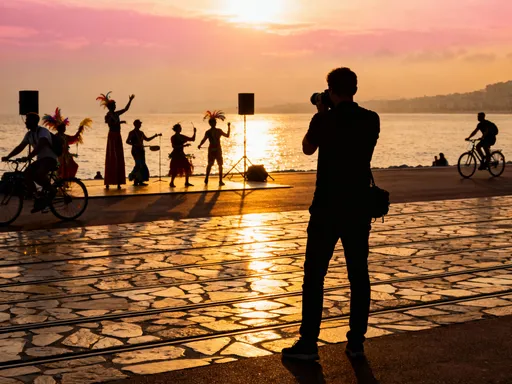
Stretching along the Mediterranean for seven kilometers, the Promenade des Anglais is more than a scenic walkway—it’s a living canvas of movement, color, and light. From sunrise to sunset, this iconic boulevard pulses with life. Joggers in bright sneakers, cyclists weaving through foot traffic, children chasing pigeons, and couples pausing for photos against the sea—all contribute to a dynamic tableau perfect for street photography. The challenge and joy lie in capturing authenticity without intrusion, freezing moments that feel both spontaneous and meaningful.
The best time to photograph the Promenade is during the golden hours—just after sunrise and before sunset. In the early morning, the light is soft and directional, casting long shadows and warm highlights on faces and pavement. The sea shimmers with a silken texture, ideal for reflections. By late afternoon, the light turns golden, bathing the pale buildings in a honeyed glow and turning the water into molten silver. This is when the promenade truly comes alive, with locals and visitors alike drawn to the water’s edge to welcome the evening.
Compositionally, the Promenade offers multiple layers: the sea in the foreground, the broad walkway in the middle, and the row of elegant Belle Époque buildings in the background. Use a mid-range zoom lens (24-70mm) to play with depth and perspective. Try shooting from a low angle to emphasize the sky and water, or use leading lines—such as the curve of the pathway or the rows of palm trees—to guide the viewer’s eye through the frame. Reflections in puddles or glass railings can add creative dimension, especially after a light rain.
Respectful photography is essential here. While candid shots are powerful, it’s important to be mindful of personal space. If photographing individuals up close, a smile and a nod can go a long way. In some cases, asking permission—especially when focusing on children or people in quiet contemplation—ensures ethical practice. The goal is not to capture people as props, but as part of a shared human experience. When done with sensitivity, street photography becomes a celebration of connection, not intrusion.
Old Town (Vieux Nice): A Kaleidoscope of Color and Texture
Step into Vieux Nice, and the world slows down. The narrow, winding streets are shaded by tall buildings with laundry strung between balconies, and the air carries the scent of jasmine, fresh bread, and ripe citrus. This historic district is a treasure trove for photographers who love detail, texture, and color. Every alleyway offers a new composition: flower stalls bursting with geraniums, tiled doorways framed by peeling paint, and sun-dappled courtyards hidden behind arched passages. Here, photography becomes an act of discovery—one frame at a time.
The Cours Saleya market is the heart of Vieux Nice and a must-visit for visual storytelling. Open daily, it transforms in the morning into a vibrant mosaic of fresh produce, local cheeses, olives, and Provence-style spices. By afternoon, many stalls are replaced with antiques and handmade crafts. The market’s energy is infectious, and the colors are intense—crimson tomatoes, golden lemons, purple artichokes, and baskets of saffron. To capture its essence, use a prime lens with a wide aperture (f/1.8 or f/2.8) to isolate subjects and blur busy backgrounds. Focus on hands—vendors arranging fruit, customers selecting herbs—as they convey intimacy and tradition.
Light in the Old Town is directional and often dappled, filtering through narrow gaps between buildings. This creates natural contrast, perfect for black-and-white photography or high-dynamic-range (HDR) color shots. Arrive early, between 7:00 and 9:00 a.m., to avoid crowds and capture quiet moments: a baker sweeping his doorstep, a cat curled on a windowsill, or a single shaft of light illuminating a cobblestone path. These images, though simple, often carry the most emotional weight.
Architectural details abound. Look for shuttered windows painted in bold blues and greens, ornate iron grilles, and tiled roofs in terracotta and slate. Use a macro lens or close-up filter to highlight textures—cracked stucco, weathered wood, or intricate tile patterns. Don’t overlook the courtyards, known locally as cours. Many are tucked behind unassuming doorways and open to the public. These hidden spaces, often with fountains and potted plants, offer serene compositions away from the bustle. Photographing them requires patience and discretion, but the results are worth it—images that feel private, peaceful, and deeply rooted in place.
Castle Hill (Colline du Château): The View That Defines Nice
Rising above the city center, Castle Hill—Colline du Château—offers one of the most iconic panoramic views in all of Europe. Once home to a 12th-century fortress (destroyed in the 18th century), the site is now a lush park crowned with panoramic overlooks. From this vantage point, the Baie des Anges unfurls in a sweeping arc, bordered by the Promenade des Anglais, the rooftops of Vieux Nice, and the distant Alps. It’s a view that belongs in every traveler’s portfolio, not just for its beauty, but for its ability to contextualize the entire city.
The climb to the top—either by foot via a stone staircase or by elevator from the Quai des États-Unis—adds a sense of journey to the experience. As you ascend, the sounds of the city fade, replaced by birdsong and the rustle of leaves. At the summit, multiple viewing platforms offer different angles. The northern terrace frames the old town and port, while the southern edge provides a full-frontal view of the Mediterranean. For wide-angle photography, a 16-35mm lens is ideal. Include foreground elements—such as the remnants of the old castle walls or the cascading waterfall near the entrance—to add depth and scale.
Golden hour here is nothing short of magical. As the sun dips below the horizon, the sky ignites in hues of amber, rose, and lavender, reflecting off the water like liquid light. This is the perfect time for long-exposure shots, using a tripod to smooth the motion of waves and create a dreamy, ethereal effect. Sunset also draws photographers and tourists alike, so arriving 30 to 45 minutes early ensures you can secure a good spot without jostling for space.
Drone photography is permitted in some areas of Nice, but regulations are strict. Flying near crowds, historical sites, or above 120 meters is prohibited without authorization. Always check local guidelines and respect privacy. Even without a drone, the view from Castle Hill is expansive enough to capture in stunning detail with a telephoto lens. Zoom in on sailboats dotting the bay, the curve of the coastline, or the play of light on building facades. Each frame tells a different part of Nice’s story—from maritime heritage to modern elegance.
Beachside Scenes: Capturing Life on the Pebbled Shores
The beaches of Nice are unlike any other on the Mediterranean. Instead of soft sand, they are covered in smooth, sun-warmed pebbles that clink underfoot and reflect light in unexpected ways. These galets, as they’re called in French, create a unique visual texture—ideal for abstract compositions, macro photography, and creative use of light and shadow. The iconic blue lounge chairs, arranged in neat rows by private beach clubs, add a pop of color against the gray stones and blue sea, making them instantly recognizable in photographs.
Photographing beach life requires a balance of artistry and ethics. While it’s tempting to capture sunbathers, swimmers, and families building pebble towers, it’s important to respect privacy. Avoid zooming in on individuals without consent, especially in swimwear. Instead, focus on candid moments from a distance—children splashing at the water’s edge, a couple sharing an umbrella, or a lone reader under a palm hat. Use a telephoto lens (70-200mm) to compress the scene and isolate subjects without intruding.
Light conditions on the beach can be challenging due to high contrast—bright skies and deep shadows under umbrellas. To manage this, use exposure compensation or shoot in RAW format to retain detail in post-processing. A polarizing filter helps reduce glare on water and pebbles, enhancing color saturation. Early morning is ideal for photography: the beach is quieter, the light is softer, and the chairs are neatly arranged before guests arrive. Sunrise over the Mediterranean casts a golden path across the waves, perfect for reflective, serene compositions.
The interaction between people and environment is central to beach photography. Look for moments that convey relaxation, joy, or quiet contemplation. A woman sketching in a notebook, a man tossing a pebble into the surf, or a dog shaking off seawater—these small gestures speak volumes about the rhythm of Riviera life. By focusing on gestures rather than faces, you preserve dignity while still capturing emotion. The pebbled shore, often overlooked, becomes a metaphor for the journey—uneven, reflective, and surprisingly beautiful under the right light.
Sunset at Quai des États-Unis: A Daily Ritual Worth Repeating
As evening approaches, a quiet pilgrimage begins along Quai des États-Unis. Photographers, couples, and solitary wanderers gather along the sea wall, facing west, waiting for the sun to kiss the horizon. This daily ritual is more than a photo opportunity—it’s a moment of collective stillness, a shared pause in the rhythm of the day. The sky transforms minute by minute: from pale gold to fiery orange, then deep crimson, and finally a soft violet as twilight takes over. Each sunset is unique, never to be repeated, making it a powerful subject for both photography and reflection.
To capture the full drama of the sunset, set up early. Bring a tripod for stability, especially if you plan to use long exposures. Start shooting when the sun is still high, then adjust settings as the light fades. Use a graduated neutral density filter to balance the bright sky with the darker foreground. For silhouettes, position subjects—such as a couple holding hands or a lone sailboat—between the camera and the sun. The effect is timeless: simple shapes against a radiant backdrop, evoking emotion without needing detail.
As the crowd grows, finding a personal space becomes essential. Instead of fighting for the center spot, explore the edges—side pathways, benches, or even reflections in nearby puddles. Sometimes the most compelling images come from unexpected angles. After the sun disappears, don’t pack up immediately. The “blue hour” that follows—when the sky turns a deep indigo and city lights begin to twinkle—offers a different kind of magic. Long exposures during this time can turn street lamps and windows into streaks of light, creating painterly effects.
Post-processing should enhance, not invent. Adjust white balance to preserve natural tones, increase contrast slightly to add depth, and use selective sharpening to bring out details in the water or architecture. Avoid oversaturating colors—authenticity matters. The goal is not to create a fantasy, but to honor what was truly seen. A well-edited sunset photo should feel familiar, as if the viewer has stood in that same spot, felt that same breeze, and watched that same sky.
Beyond the Frame: How Photography Deepens Travel Connection
Photography, at its best, is not just about taking pictures—it’s about paying attention. On the French Riviera, every click of the shutter became an act of presence. To capture light, I had to notice when it shifted. To frame a moment, I had to wait for it. To compose an image, I had to slow down and truly see. In a world that often moves too fast, photography became my way of grounding myself in the now. It taught me to observe not just the grand vistas, but the small details: the way a child’s shadow stretched across the promenade, the pattern of tiles on a rooftop, the laughter shared over a café table.
This mindful approach transformed my experience of travel. Instead of rushing from one landmark to the next, I found myself lingering—watching, listening, feeling. Photography encouraged me to connect with locals, not as subjects, but as fellow humans. A smile exchanged with a flower vendor, a nod from an elderly man reading a newspaper—these moments, though not always captured in photos, became part of my internal album. The camera didn’t distance me from the experience; it deepened it.
There’s also a legacy to consider. The images we take become more than souvenirs—they become stories we can share with loved ones, memories we can revisit decades later. A photograph of Castle Hill at sunset might one day prompt a conversation with a grandchild: “This is where I stood, on a warm evening in June, feeling completely at peace.” In this way, photography becomes a bridge between past and future, a way of carrying beauty forward.
The French Riviera, with its luminous light and timeless elegance, is a gift to photographers. But the real reward isn’t the perfect shot—it’s the way the lens changes how you see. It teaches patience, gratitude, and wonder. It reminds you that beauty exists not just in postcard views, but in the quiet corners, the fleeting glances, the play of shadow and light on an ordinary street. So the next time you travel, bring your camera—not to capture everything, but to help you truly see. Let it guide you not just to famous landmarks, but to moments that speak to your soul. Because in the end, the most powerful photographs aren’t the ones we hang on walls—they’re the ones we carry in our hearts.